Getting behind the wheel in the UAE is straightforward once you know where your home country’s licence sits in the system. Some nationalities convert directly with no test at all. Others need the full course from scratch. And a few fall into a middle tier that most articles don’t mention, where you skip the theory and parking tests but still sit a road test. Getting this wrong at the start costs months of unnecessary lessons and several thousand dirhams. What follows maps out exactly where you land and what each route costs.
On this page
Converting a foreign licence to UAE
The UAE divides foreign licences into 3 tiers. Which tier you fall into determines whether you need no test at all, just a road test, or the full course.
| Tier | Countries | What’s required | Approx. cost |
|---|---|---|---|
| Direct exchange No test required |
GCC countries, UK, USA, Canada, Australia, Germany, France, South Africa, Turkey, Japan, South Korea, and 30+ others | Eye test, RTA application, valid home licence, Emirates ID, passport copy | AED 400 to AED 600 |
| Partial exemption Road test only |
India, Pakistan, Philippines, Egypt, Lebanon, Jordan, and several others | Eye test, theory exemption, parking test exemption, road test with RTA examiner | AED 800 to AED 1,500 |
| Full course All tests required |
All other nationalities not covered above | Theory test, parking test, road test, minimum required driving hours at accredited school | AED 3,900 to AED 5,300 |
The RTA’s confirmed list of eligible direct-exchange countries changes periodically. Check the RTA official portal before assuming your nationality qualifies for direct exchange, since several countries shifted tiers in 2024 and 2025.
One detail that catches people out: your home licence must have been valid for at least 1 year to qualify for any conversion route. A licence issued less than 12 months ago, even from a direct-exchange country, may require additional road tests regardless of nationality.
Getting a UAE licence from scratch
The full process runs through 7 stages, from registering at a driving school to collecting the licence on the day you pass. Total cost for most people lands between AED 4,000 and AED 6,000 depending on how many extra hours and retests are needed. The timeline is typically 2 to 4 months, though it stretches to 6 months or more for learners who struggle with the road test.
| Stage | What happens | Cost | Timeline |
|---|---|---|---|
| Registration | Eye test, file opening at driving school, Emirates ID and passport submission | AED 200 to AED 400 | Day 1 |
| Theory classes | UAE traffic laws, road signs, rules, typically 8 to 12 hours | Included in school package | 1 to 2 weeks |
| Theory test (RTA) | Computer-based multiple choice, 35 questions, pass mark 90% | AED 25 per attempt | After theory classes |
| Practical lessons | Minimum hours vary by school package. Most beginners need 20 to 40 hours total | AED 100 to AED 140 per hour top-up | 4 to 12 weeks |
| Parking test (RTA) | Parallel parking, angle parking, hill start on a closed test course | AED 10 per attempt | After minimum hours |
| Road test (RTA) | 20 to 30 minute drive on public roads with RTA examiner. Strict standards, high first-attempt fail rate | AED 10 per attempt | After parking test pass |
| Licence issuance | UAE driving licence issued, valid for 10 years for residents | AED 120 | Same day as road test pass |
The road test first-attempt pass rate in Dubai sits below 50% for most schools. That is not a reason to panic but it is a reason to take the test only when your instructor confirms you are genuinely ready, not just after completing the minimum required hours.
Driving schools in Dubai: cost comparison
All 4 major RTA-accredited driving schools in Dubai offer broadly similar packages at similar prices, since fees are partly regulated. The real differences are in location convenience, language of instruction, and how quickly they can schedule your tests. If you live near Al Quoz, any of them work. If you are in Deira, Emirates Driving Institute or Galadari are the more practical options.
| School | Package range | Locations | Known for |
|---|---|---|---|
| Emirates Driving Institute (EDI) | AED 3,918 to AED 4,500 | Al Quoz, Deira, Muhaisnah | Largest network, multilingual instructors |
| Galadari Motor Driving Centre (GMDC) | AED 3,918 to AED 5,283 | Al Quoz, Deira, Karama | Defence driving, motorcycles, forklifts |
| Belhasa Driving Centre (BDC) | AED 3,983 to AED 5,078 | Al Quoz, Qusais, Jebel Ali | Business and first class premium options |
| Al Ahli Driving Center | AED 3,800 to AED 4,200 | Al Quoz | Budget-friendly, flexible schedules |
Car insurance in the UAE
Insurance is mandatory before a car can be registered or driven legally in the UAE. The type you need depends on whether the car is financed and how old it is. Third party is the legal minimum but most lenders require comprehensive. The distinction that actually matters day-to-day is whether your comprehensive policy includes agency repair, since that determines where your car goes if it is damaged.
| Type | What it covers | Annual cost (approx.) | Required for |
|---|---|---|---|
| Third party | Damage or injury to others only. No cover for your own vehicle | AED 600 to AED 1,200 | Legal minimum for registration |
| Comprehensive | Third party plus own vehicle damage, theft, fire | AED 1,500 to AED 5,000 | Required by most car finance lenders |
| Comprehensive with agency repair | All of above, with repairs done at brand’s own authorised service centre | AED 2,500 to AED 8,000 | Recommended for new cars under 3 years old |
Agency repair is the most frequently misunderstood insurance distinction in the UAE. Without it, a comprehensive policy still covers repairs but sends your car to a third-party garage rather than the brand’s own network. For a new car under 3 years old, that difference in repair quality matters. For an older car where agency servicing costs exceed the car’s value, it usually doesn’t.
Vehicle registration and Mulkiya
The Mulkiya is the UAE vehicle registration card, renewed annually. Before renewal, the car needs a roadworthiness test at an RTA-authorised testing centre. Insurance must also be active before the Mulkiya can be issued or renewed, so the sequence is always: test first, insurance second, Mulkiya third. If you are also driving in Abu Dhabi, Darb registration is a separate one-time step.
| Item | Cost | Frequency | Notes |
|---|---|---|---|
| Annual vehicle test | AED 150 to AED 200 | Annual | Required before Mulkiya renewal |
| Mulkiya renewal | AED 350 to AED 500 | Annual | Requires valid insurance first |
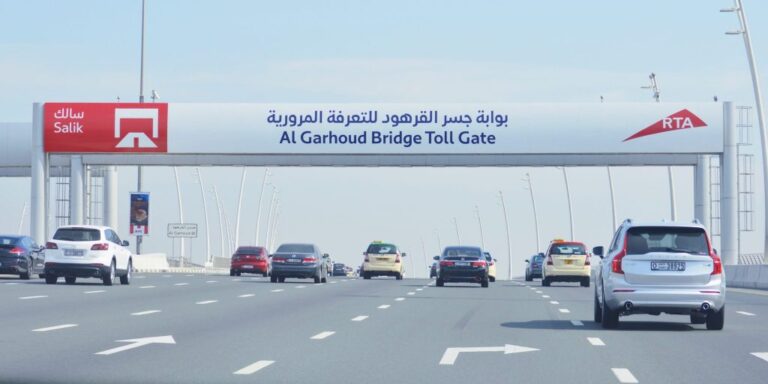
| Salik tag (Dubai) | AED 50 (tag) + wallet top-up | Once | Mandatory for driving through Dubai toll gates |
| Darb registration (Abu Dhabi) | AED 100 (AED 50 back as credit) | Once per vehicle | Required for Dubai-registered cars driving in Abu Dhabi |
Tolls: Salik (Dubai) and Darb (Abu Dhabi)
Both systems deduct charges automatically, but they work differently. Salik requires a physical RFID sticker on your windscreen linked to a pre-paid wallet. Darb uses plate recognition cameras and requires no device at all, just a registered account with a funded balance. The key difference in daily cost is that Salik uses variable pricing while Darb charges a flat AED 4 per gate regardless of time. If you regularly drive between Dubai and Abu Dhabi, both systems apply and both wallets need to stay funded.
| Salik (Dubai) | Darb (Abu Dhabi) | |
|---|---|---|
| Device needed | RFID sticker on windscreen | None, plate recognition |
| Peak rate (incl. VAT) | AED 6.30 | AED 4.00 (flat) |
| Off-peak rate | AED 4.20 | AED 4.00 (same) |
| Free window | 1am to 6am daily | Sundays and public holidays (original 4 bridges only) |
| More detail | All Salik gates, fines and top-up | All 6 Darb gates, registration, exemptions |
Parking in Dubai
Public parking in Dubai is managed by Parkin. Payment is cashless only, via the Parkin app, SMS to 7275, or Nol card tap at kiosks. Rates vary by zone and time of day. Sunday is free in standard public zones. Late night parking from 10pm to 8am is free in most outdoor public areas.
| Zone | Areas | Peak rate / hour | Off-peak rate / hour |
|---|---|---|---|
| Category A (Premium) | Downtown, Business Bay, SZR, Marina | AED 6.30 | AED 4.20 |
| Category B (Standard) | Al Barsha, Karama, Deira, Bur Dubai | AED 4.20 | AED 2.10 |
DIFC operates its own separate parking system outside the standard Parkin zone structure, and certain residential areas have designated free bays. The full zone map, overnight rules, and DIFC-specific charges are in parking across Dubai.
Buying vs renting a car
The honest answer is that buying makes sense once you are confident you will stay for at least 2 years and drive regularly. Below that threshold, a monthly rental avoids registration costs, insurance commitment, and the difficulty of selling a car inside 12 months at a fair price.
| Situation | Better option | Why |
|---|---|---|
| On a 1-year contract, renewal uncertain | Rent monthly | Avoids resale risk and sunk registration costs |
| Commuting daily, staying 2+ years | Buy | Monthly ownership cost falls below equivalent rental after 18 to 24 months |
| Metro-accessible workplace, occasional driving | Metro + Hala + monthly rental | Total cost almost always lower than full ownership |
| Just arrived, need immediate transport | Rent short-term first | Gives time to settle on area, commute route, and actual driving needs before committing |
For anyone weighing whether to buy, the Chinese brand vs Japanese residual value gap, financing deposit rules, and true first-year ownership cost are all worth running through before visiting a showroom. Monthly rental costs, the 42-country licence list, and what rental companies actually check before handing over keys are in renting a car in Dubai. For residents who rely on a mix of driving and public transport, getting around the UAE without a car costs significantly less than most people assume before they do the numbers.