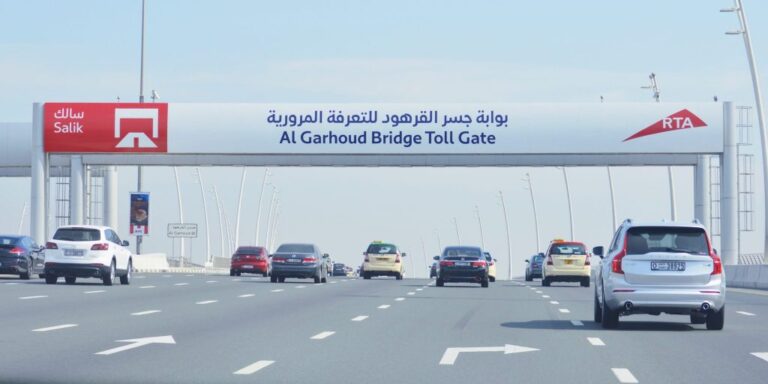
If your car is registered in Dubai, you still need to register separately for Abu Dhabi’s toll system before you cross the border. Most people only find out when the fines have already started. Darb works differently from Salik in almost every way: no sticker, no tag, a flat rate regardless of time of day, and since May 2026, two new gates that charge 24 hours a day including Sundays and the one right on the Dubai–Abu Dhabi highway.
1. How Darb works
Darb launched in January 2021 under Law No. 17 of 2017, introduced by the Department of Municipalities and Transport through Abu Dhabi’s Integrated Transport Centre. Automated number plate recognition cameras sit above the road at each active gate. You drive through at normal speed with no stopping, no slowing, no booth interaction. The charge is deducted automatically from a pre-loaded e-wallet that you register online or through the Darb app.
The only thing required of you is to register your vehicle and keep your wallet funded before crossing any gate. For Dubai residents who regularly drive to Abu Dhabi, this is the equivalent of maintaining a Salik balance, except with no physical sticker involved at all.
2. The 6 toll gate locations
There are 6 active Darb gates as of May 2026, split across 2 distinct types that operate on completely different schedules.
The original 4 gates sit on the bridges connecting Abu Dhabi Island to the mainland:
| Gate Name | Location | Operating Schedule |
|---|---|---|
| Sheikh Zayed Bridge | Main eastern crossing to the island | Peak hours only, Mon to Sat |
| Sheikh Khalifa bin Zayed Bridge | Near Al Maqtaa, south of the island | Peak hours only, Mon to Sat |
| Al Maqtaa Bridge | Older crossing between island and mainland | Peak hours only, Mon to Sat |
| Mussafah Bridge | Mussafah industrial area connection | Peak hours only, Mon to Sat |
| Ghantoot Gate NEW MAY 2026 | Sheikh Maktoum bin Rashid Street, near Dubai border | 24 hours, 7 days a week |
| Al Qurm Gate NEW MAY 2026 | Wahat Al Karama Street, entrance to Sheikh Zayed Street | 24 hours, 7 days a week |
Ghantoot is the gate that matters most for Dubai residents. It sits directly on the main highway between the 2 emirates, which means every trip to Abu Dhabi now includes a AED 4 charge each way, at any hour, on any day.
3. Peak hours and when you pay
| Gate Type | Days Active | Morning Peak | Evening Peak | Free Windows |
|---|---|---|---|---|
| Original 4 bridges | Mon to Sat | 7:00am to 9:00am | 3:00pm to 7:00pm | All day Sunday, public holidays, overnight |
| Ghantoot and Al Qurm | Every day | All hours | All hours | None |
Sundays are not free at Ghantoot and Al Qurm. Public holidays are not free. There is no time at which you can pass through either of these 2 gates without being charged. This is the most important change in Darb’s history and the one most frequently missed by residents who learned the system before May 2026.
During Ramadan, the original 4 bridge gates adjust their peak windows to reflect the shifted working day. The 2 new highway gates remain 24-hour regardless. Check the official TAMM portal for confirmed Ramadan timing adjustments each year.
4. What it costs
| Crossing Type | Cost Per Crossing | Daily Cap | Monthly Cap |
|---|---|---|---|
| All 6 active gates | AED 4.00 | None | None (abolished Sept 2025) |
| Commercial vehicles (Category 2+) | AED 8.00 to AED 16.00 | None | None |
The monthly cap of AED 200 per car was abolished in September 2025. There is no ceiling on what you now pay in a month. A Dubai resident commuting daily to Abu Dhabi, crossing Ghantoot plus 1 island bridge each way, 5 days a week, is paying AED 320 per month in Darb charges alone before any other transport costs. The transport cost breakdown is worth running against your actual commute route before assuming your current budget still holds.
5. How to register your vehicle
| Step | What’s required | Cost |
|---|---|---|
| Create a Darb account | Valid Emirates ID, email, mobile number | Free |
| Register vehicle | Licence plate number and traffic file number | AED 100 (AED 50 credited back to wallet) |
| Fund your wallet | Darb app, online portal, or bank card | Minimum top-up AED 50 |
| Enable auto top-up | Set a trigger threshold and recharge amount | Strongly recommended |
Registration must be completed at least 10 working days before your first crossing if your vehicle is registered outside Abu Dhabi. The net registration fee is AED 50 once the wallet credit is applied. Commercial vehicles require additional documents including a trade licence and a company-stamped vehicle list.
6. Fines and what happens if your wallet runs dry
| Scenario | Grace Period | Fine | Annual Cap |
|---|---|---|---|
| Crossing with empty wallet | 5 working days to top up | AED 50 per crossing after grace period | AED 25,000 per vehicle |
| Unregistered vehicle crossing | First-time grace window | AED 50 per day after grace | AED 25,000 per vehicle |
Auto top-up is not optional advice, it is the only reliable way to avoid fines when you are crossing gates daily. Passing through Ghantoot at midnight with an empty wallet still triggers the fine process.
7. Rental cars and visitors
If you are renting a car and driving into Abu Dhabi, you do not need to register anything yourself. The rental company is legally required to register the vehicle in Darb. Every crossing is logged against the plate and invoiced when you return the car, usually with an administration fee added on top. Ask the rental company what their Darb processing charge is before signing the agreement, since it varies and is rarely displayed prominently. If you are renting across both emirates, the full car rental process covers what to watch for before signing.
8. Who pays nothing
| Category | Exemption Type | Application Required |
|---|---|---|
| Motorcycles | Automatic | No |
| Licensed taxis | Automatic | No |
| School buses, public buses (26+ passengers) | Automatic | No |
| Police and emergency vehicles | Automatic | No |
| People of Determination | 1 vehicle per person | Yes, via Darb portal |
| Senior citizens (60+) | 1 vehicle per person | Yes, via Darb portal |
| Retired UAE nationals | 1 vehicle per person | Yes, via Darb portal |
| Low-income Emiratis | 1 vehicle per person | Yes, via Darb portal |
9. Darb vs Salik: the key differences
| Feature | Darb (Abu Dhabi) | Salik (Dubai) |
|---|---|---|
| Device required | None, plate recognition only | RFID sticker on windscreen |
| Pricing model | Flat AED 4 per crossing | AED 6.30 peak, AED 4.20 off-peak (VAT incl.) |
| Free windows | Sundays and public holidays (original 4 only) | 1:00am to 6:00am daily |
| 24-hour gates | Ghantoot and Al Qurm (from May 2026) | All gates charge all hours except 1-6am |
| Monthly cap | None (abolished Sept 2025) | None |
| Fine for non-payment | AED 50 per crossing after 5-day grace | AED 50 per crossing after 5-day grace |
Salik, Dubai’s equivalent toll system, uses variable pricing of AED 6.30 peak and AED 4.20 off-peak including VAT since January 2025, a different model from Darb’s flat AED 4 per crossing.