Renting a car in Dubai costs as little as AED 70 per day for an economy car, but the advertised daily rate is never the full cost. Salik tolls, fuel, deposits, insurance add-ons, and hidden admin charges can push the real daily spend 30% to 60% above the sticker price. This guide covers realistic pricing, what documents you actually need, the licence rules most guides get wrong, and the specific charges that catch people out.
What it actually costs
Rental rates in Dubai vary significantly by vehicle type, season, and whether you book through an aggregator or directly with a company. The table below shows the realistic range as of June 2026, not the lowest possible advertised price you will rarely qualify for.
| Car type | Daily | Weekly | Monthly | Best for |
|---|---|---|---|---|
| Economy (Yaris, Sunny, Picanto) | AED 70 to AED 120 | AED 400 to AED 700 | AED 1,500 to AED 2,000 | Solo travellers, city driving |
| Mid-size sedan (Corolla, Accent) | AED 100 to AED 180 | AED 600 to AED 1,000 | AED 1,900 to AED 2,500 | Couples, highway driving |
| SUV (Sportage, Fortuner, RAV4) | AED 150 to AED 400 | AED 900 to AED 2,500 | AED 3,000 to AED 5,000 | Families, desert trips |
| Luxury (BMW 5, Mercedes E, Range Rover) | AED 500 to AED 1,500 | AED 3,000 to AED 8,000 | AED 10,000+ | Business, special occasions |
| Sports and exotic (Ferrari, Lambo) | AED 1,500 to AED 5,000+ | AED 8,000+ | AED 25,000+ | Special occasions |
Peak season from November to March typically adds 10% to 20% to these rates. Weekly and monthly bookings save 30% to 50% compared to daily rates. The real daily cost on a AED 100 economy car is closer to AED 130 to AED 160 once you add fuel (AED 15 to AED 25), Salik tolls (AED 8 to AED 30 depending on your route), and parking. Budget at least 30% above the advertised rental rate for your true daily cost. For residents deciding whether renting long term makes more sense than owning, the ways to save money in Dubai guide covers the transport cost comparison honestly.
Licence requirements by nationality
This is where most guides give incomplete information. Dubai has four categories of licence acceptance and which one applies to you determines whether you need an International Driving Permit before you arrive.
Category 1: Use your home country licence directly. The following nationalities can drive in Dubai on their home licence without an IDP as a tourist on a visit visa.
Europe: UK, Ireland, Germany, France, Spain, Italy, Austria, Belgium, Denmark, Finland, Sweden, Switzerland, Netherlands, Norway, Czech Republic, Greece, Hungary, Latvia, Lithuania, Luxembourg, Malta, Poland, Portugal, Slovakia, Slovenia.
Rest of world: USA, Canada, Australia, New Zealand, South Africa, Singapore, Japan, South Korea, Israel, Cyprus, Iceland, Turkey.
GCC: Saudi Arabia, Qatar, Kuwait, Bahrain, Oman.
Two caveats worth knowing. First, if your licence is not printed in English or Arabic, most rental companies will ask for an IDP or an official translation regardless of your nationality. A French licence issued in France is fine. A licence issued in a language that counter staff cannot read creates friction even if your nationality is on the list. Second, many rental companies in Dubai apply their own internal policy and require an IDP as a standard condition of rental even for nationalities on the accepted list. Being on the list gives you the legal right to drive but does not guarantee the rental company will hand over the keys without one. If there is any doubt, get an IDP in your home country before travelling. It costs the equivalent of AED 75 to AED 100 and takes under an hour at most national automobile clubs.
Category 2: Home licence plus an International Driving Permit. Nationalities not on the direct-acceptance list need an IDP alongside their home licence. The IDP must be obtained in your home country before travelling to the UAE, since you cannot apply for one in Dubai. It is issued by your national automobile club or equivalent authority and costs the equivalent of AED 50 to AED 150 depending on country. Many countries issue it same day or within 24 hours.
Category 3: UAE residents with a UAE driving licence. If you hold a UAE resident visa and a UAE issued driving licence, you can rent using that licence. Note that some rental companies require a minimum of six months residence in the UAE for resident rates and lower deposits.
Category 4: Indian, Pakistani, and several other South Asian nationality licences. These require a UAE driving licence rather than just an IDP to rent from most mainstream companies, though some smaller rental companies accept them with an IDP. Verify before booking if this applies to you.
Minimum age is 21 for standard vehicles at most companies. Luxury and sports cars typically require a minimum age of 25, and some exotic vehicle providers require 30 with a minimum of five years’ driving experience. Adding an unlisted driver to the vehicle violates UAE Federal Law No. 31 of 2021 and can result in a fine of AED 10,000. Always add all potential drivers to the rental contract before driving, not as an afterthought at the counter.
Insurance options explained
Every rental car in Dubai comes with mandatory third-party liability insurance included in the base rate. This covers damage you cause to other vehicles and property. It does not cover damage to the rental car itself.
CDW (Collision Damage Waiver): Reduces your financial liability for damage to the rental car to a fixed excess amount, typically AED 1,000 to AED 3,000. If the car is damaged, you pay the excess and the insurance covers the rest. CDW does not cover windscreen damage, tyres, or the underside of the vehicle unless SCDW is also taken.
SCDW (Super Collision Damage Waiver): Extends CDW to cover windscreen, tyres, and roadside assistance. This is the full protection option and effectively reduces your liability to zero for damage, subject to exclusions for gross negligence and traffic law violations. If you are involved in an accident while breaking a traffic law, even a minor one like a speed camera fine, the insurance can be voided.
PAI (Personal Accident Insurance): Covers medical costs for the driver and passengers in the event of an injury. Typically AED 10 to AED 20 per day. If your travel insurance already covers accidents, this is likely redundant.
The honest assessment: CDW is worth taking at minimum for almost any rental unless you have a credit card that provides rental car damage coverage automatically, which some premium UAE credit cards do. Check your card benefits before paying for CDW. SCDW is worth taking for longer rentals and when driving on sand or in unfamiliar areas where minor damage is more likely.
Salik tolls: what rental companies do not always tell you
Every rental car in Dubai comes with a Salik tag pre-installed on the windshield. You do not need to do anything to use it. Every time you pass through a Salik gate, the toll is automatically recorded and charged to your account by the rental company at the end of your rental period.
The current Salik rates as of 2026 are AED 4 per gate crossing during off-peak hours and AED 6 per gate crossing during peak hours. All gates are free between 1am and 6am daily. There is no daily cap, each crossing is charged separately.
The detail most rental guides miss: some rental companies add an administrative markup of AED 1 per Salik transaction on top of the actual toll cost. Ask specifically whether your Salik charges will be billed at cost or with an admin fee. The better rental companies bill at cost with no markup.
If you are driving between Dubai and Abu Dhabi, Abu Dhabi operates its own separate toll system called Darb, which works similarly to Salik. Rental cars crossing into Abu Dhabi will also have Darb charges recorded and billed. This is rarely mentioned at booking time and can appear as a surprise charge on your final invoice if you took any excursions to Abu Dhabi, Al Ain, or other areas outside Dubai.
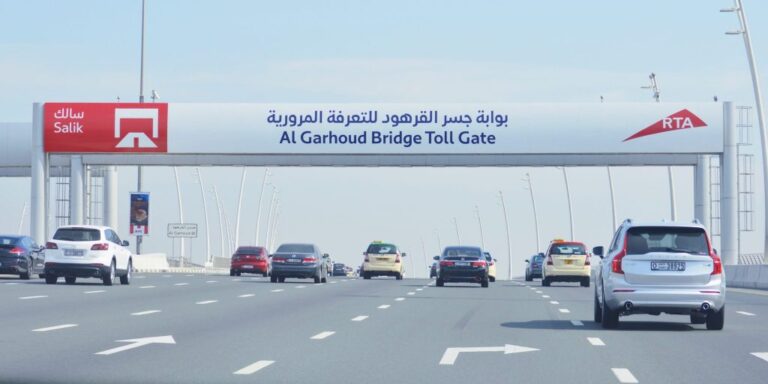
Major Salik gates are on Sheikh Zayed Road at several points, on Al Maktoum Bridge and Al Garhoud Bridge, and on Al Mamzar approaches. If you are driving between JBR and Dubai Marina to Downtown or Deira, you will typically cross two to three gates. Sheikh Zayed Road between Dubai Marina and Business Bay passes several gates in each direction. Plan accordingly or use the Nol or RTA map to route around gates if cost is a concern.
Fuel policy
The large majority of Dubai rental companies operate a same-to-same fuel policy: you collect the car with a specific fuel level and must return it at the same level. If you return it lower, you will be charged for the fuel shortfall plus a refuelling service fee that is typically two to three times the actual pump price. Always photograph the fuel gauge at collection and at return.
A small number of companies offer a full-to-full policy where you collect with a full tank and return full. This is the cleanest option and removes any ambiguity about fuel levels.
Petrol in Dubai costs approximately AED 2.90 to AED 3.20 per litre for 95 octane in June 2026. Fuel prices in the UAE are revised monthly by the government. An economy car covering 100km per day will cost roughly AED 18 to AED 25 in fuel at current prices.
Deposits and how long they take to come back
Most rental companies hold a security deposit at the start of the rental period by blocking the amount on your credit card. The deposit is not charged; it is a temporary hold that reduces your available credit until released. Cash deposits are accepted by some companies but the return timeline is longer.
Deposit amounts vary by vehicle and company. Economy cars typically require AED 500 to AED 1,500. Luxury cars AED 3,000 to AED 10,000. Sports and exotic vehicles AED 10,000 to AED 50,000. Some companies distinguish between residents and tourists, with residents typically qualifying for lower deposits.
The deposit hold is released after the final invoice is settled, which includes any Salik tolls, traffic fines, and fuel charges that the company needs time to compile. In practice this means the deposit is rarely released the day you return the car. Allow 7 to 21 days for the release to appear on your statement. Some companies release within 48 to 72 hours, but this is the exception. If you need the credit available quickly, ask specifically at booking time what the expected release timeline is.
Hidden charges to watch for
Airport surcharge: Picking up or dropping off at Dubai International Airport adds 10% to 20% to the base rate at most companies. Picking up at an off-airport location or arranging delivery saves this cost.
Mileage limits: Most daily and weekly rentals include a mileage cap, typically 200km per day for daily rentals and 4,500km per month for monthly rentals. Excess mileage charges run AED 0.30 to AED 0.80 per kilometre. If you are planning a road trip to Oman or driving frequently between Dubai and Abu Dhabi, verify the mileage cap before booking. Monthly rentals often have more generous caps.
Young driver surcharge: Drivers aged 21 to 24 typically pay an additional AED 20 to AED 50 per day at most companies.
Late return: Returning a car more than one hour late typically triggers a full additional day’s charge at many companies. The grace period varies between 30 minutes and two hours depending on the company. Clarify this at pickup.
Traffic fines: Any traffic fines issued during the rental period are your responsibility. Dubai’s camera network is extensive and fines are linked to the vehicle’s licence plate. The rental company receives notification via the Dubai Police system and will add the fine amount plus an administrative fee, typically AED 30 to AED 100, to your final bill or deduct it from the deposit. Paying any outstanding fine at a Dubai Police or RTA kiosk during your rental does not remove the administrative processing charge.
Where to compare and book
Aggregator platforms including RentalCars.com, Kayak, and Skyscanner search multiple companies simultaneously and typically offer lower rates than booking directly. They also provide useful price match guarantees and free cancellation on most bookings. The main limitation is that insurance options and add-on fees are not always shown clearly until checkout, so always read the final price breakdown before confirming.
For monthly or longer-term needs, Invygo is a Dubai-based car subscription platform that covers insurance, maintenance, registration, and licence fees in one monthly payment with no long-term commitment. It suits residents who need a car for two to six months without wanting to buy. The Nol card and RTA discounts guide is worth reading alongside this if you are deciding between renting and relying on public transport, since the Metro and bus network covers more of Dubai than most newcomers expect.
Dubai traffic rules renters need to know
Speed limits range from 40km/h in residential areas to 120km/h on major highways, with a 20km/h tolerance on most roads before cameras trigger. This tolerance is not guaranteed and should not be relied upon. Speed camera locations are marked with advance warning signs on all major roads.
Mobile phone use while driving carries a AED 800 fine. Seatbelts are mandatory for all passengers. The blood alcohol limit is zero with no exceptions, not 0.05 as in most European countries. Tailgating carries significant fines and is heavily enforced. Lane discipline, including cutting across multiple lanes, is also actively enforced.
You may drive a Dubai-rented car into any other UAE emirate including Abu Dhabi, Sharjah, and Ras Al Khaimah without additional permission. Driving a rented car into Oman requires explicit written permission from the rental company and additional insurance. Most mainstream rental companies permit Oman trips with advance notice. Driving into Saudi Arabia is generally not permitted under standard rental agreements.
Parking in Dubai is metered in most commercial and tourist areas. The free parking in Dubai guide covers which areas and times are free, which is useful if you are parking regularly in Marina, Downtown, or Jumeirah Beach areas where metered zones operate seven days a week.